
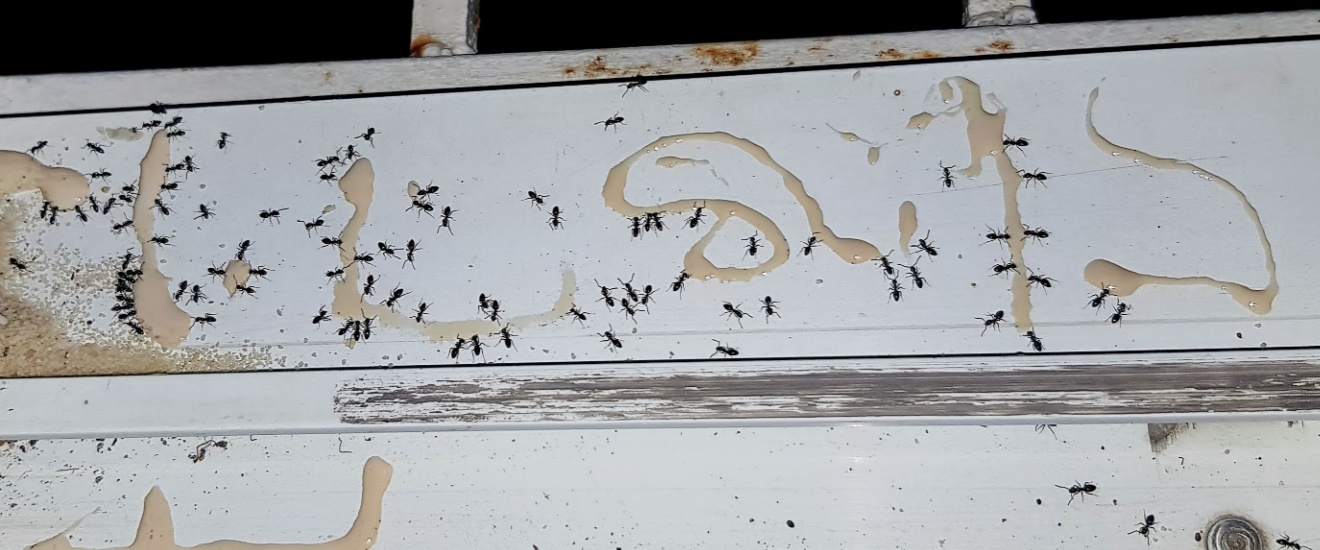
If ants have become a recurring problem in your Bethesda home, cleaning the trail and spraying the baseboard are not going to resolve it. The colony producing those ants is living in the soil near your foundation, and it will continue sending foragers inside until it is eliminated. Here is a step-by-step process for getting rid of ants and keeping them out, starting with what you can do today and progressing to the professional ant control that delivers lasting results.
Step 1: Identify the Species
Look closely at the ants in your home. Small, dark ants trailing in organized lines along counters or baseboards are most likely odorous house ants or pavement ants—the most common indoor species in Montgomery County. Large, dark ants (quarter inch or bigger) seen individually or at night may be carpenter ants—a species that excavates galleries inside moisture-damaged wood and causes structural damage. If you are finding sawdust-like shavings near wood trim or structural members, carpenter ants should be investigated by a professional immediately.
Step 2: Clean the Trail
Wipe the active trail with soapy water. This breaks the pheromone signal guiding other foragers to the same location. Do not use a consumer repellent spray—it will cause ants to reroute to different entry points and can trigger colony fragmentation with multi-queen species, making the problem worse.
Step 3: Eliminate the Attractant
Find what the ants are after and remove access. If the trail leads to food—crumbs, grease, or pet food—clean the source and store food in sealed containers. If the trail leads to a sink, faucet, or pipe, the ants are seeking water. Fix dripping faucets. Wipe down sinks before bed. Address condensation on pipes under sinks.
Step 4: Seal the Entry Point
If you can identify where ants are entering—a crack in the baseboard, a gap around a pipe, worn weatherstripping—seal it with caulk or weatherstripping. This closes the immediate pathway. Be aware that the colony has access to multiple potential entry points, so sealing one may redirect traffic to another.
Step 5: Call for Colony-Level Treatment
Steps 1 through 4 address the visible situation. They do not reach the colony. Professional ant control uses non-repellent products that foragers carry back to the nest. The product spreads through the colony via contact and food sharing, reaching the queens over one to three weeks. The colony collapses from within.
A professional also provides exterior barrier treatment that maintains a treated zone around the foundation for weeks—intercepting new foragers before they reach the home. Interior crack-and-crevice treatment at confirmed entry points provides additional protection.
Step 6: Maintain the Environment
Between professional visits, homeowner habits determine how long the results last:
- Keep kitchen surfaces clean and food stored properly
- Fix moisture issues promptly
- Pull mulch back from the foundation
- Trim vegetation away from the home’s exterior.
- Seal new cracks and gaps as you discover them
- Report new ant activity to your provider—complimentary retreats are included with Pestechs service plans
Step 7: Stay on a Maintenance Program
Bethesda’s humid climate and dense suburban landscape support ant colony networks that continuously recolonize residential properties. A one-time treatment eliminates the current colony. Recurring service maintains the barrier that prevents the next one from reaching the inside of your home.
Pestechs offers ant control—including carpenter ant treatment—as part of both Silver and Gold plans, with quarterly, bi-monthly, or monthly service frequency.
If ants keep coming back in your Bethesda home, contact Pestechs for a free estimate and get treatment that targets the colony, not just the trail.