
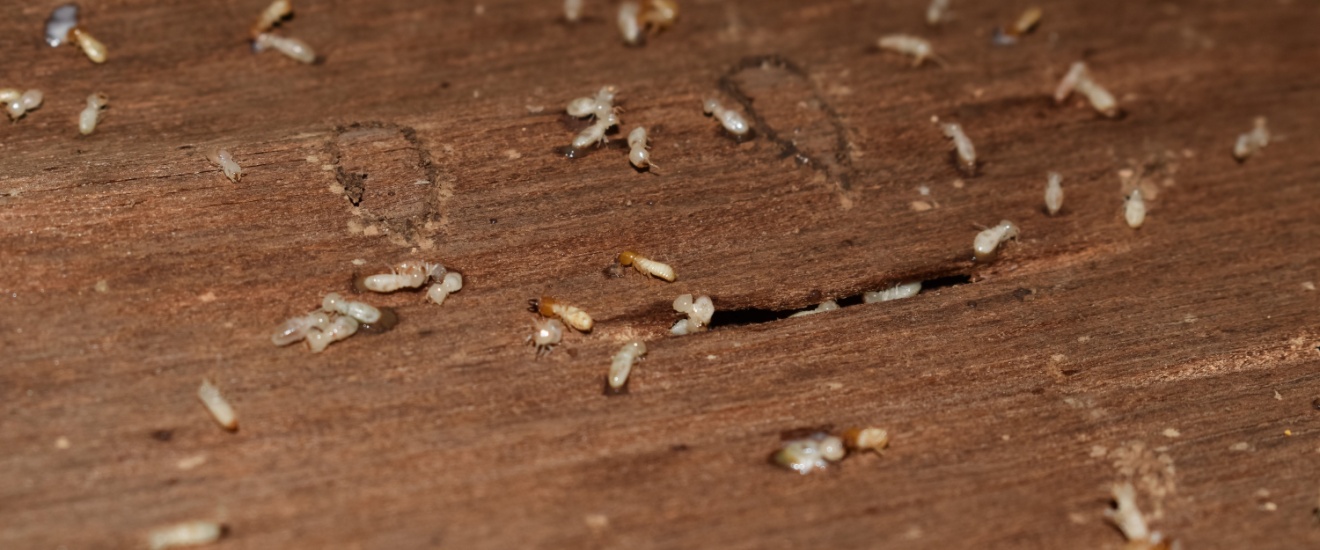
Termite infestations in Rockville are often discovered during a home sale inspection, a renovation project, or when visible damage finally becomes too obvious to ignore. By that point, the colony has typically been feeding for years. Catching an infestation earlier—when treatment is simpler and repair costs are lower—depends on knowing what to look for and where to look. Here are the signs that indicate termite activity in your Rockville home.
Mud Tubes
Mud tubes are the most visible and most definitive sign of subterranean termite activity. They are pencil-width tunnels made of soil, saliva, and fecal material that termites build to travel between the colony in the soil and the wood in the structure.
Where to look: the exterior and interior surfaces of the foundation wall, on piers in crawl spaces, along plumbing penetrations that pass through the foundation, on the walls of the basement near the floor, and in the garage along the base of the walls.
Mud tubes may be a single straight line running vertically up the foundation, or they may branch and follow irregular paths along the surface. They can be active (containing live termites when broken) or abandoned (empty, indicating past activity that may have shifted to a different location). Both warrant professional inspection.
Finding even a single mud tube on your Rockville home’s foundation should prompt an immediate professional termite inspection. Where there is one tube, there are typically more—and the colony behind it may be large.
Swarmer Activity
Termite swarmers are the winged reproductives that mature colonies produce in spring—typically March through May in the DMV. Swarming events are triggered by warm, humid conditions, often after a spring rain.
- What they look like: Small (roughly 3/8 inch including wings), dark-bodied, with two pairs of wings that are roughly equal in length. They are attracted to light and are often found near windows, on windowsills, near exterior doors, and around light fixtures.
- What they indicate: Finding swarmers inside your Rockville home means a colony is present in or immediately adjacent to the structure. Finding them outside near the foundation means colonies are active in the soil around your home.
- Shed wings: After swarmers land and pair off, they shed their wings. Small, translucent, equal-length wing pairs found on windowsills, on basement floors, or in light fixtures are a strong indicator of a swarming event that occurred in or near the home.
- Termite vs. ant swarmers: This is a common misidentification. Termite swarmers have a broad body with no visible waist, straight beaded antennae, and two pairs of equal-length wings. Ant swarmers have a pinched waist, elbowed antennae, and a front pair of wings noticeably longer than the back pair. The distinction matters because the treatment for each is completely different.
Wood Damage
Termite-damaged wood in Rockville homes is most commonly found at or near the ground level—sill plates, band boards, floor joists, door frames at ground level, and the base of basement stair stringers.
- Hollow-sounding wood: Tap on wood surfaces near the foundation with a screwdriver handle. Sound, undamaged wood produces a solid tone. Termite-damaged wood sounds hollow or papery because the interior has been consumed while the outer shell remains intact.
- Soft or easily punctured wood: Probing suspected areas with a screwdriver or awl may reveal wood that is soft, crumbly, or gives way easily—indicating the interior has been consumed.
- Blistering or darkening on wood surfaces: Termite galleries just beneath the surface of the wood can cause the surface to blister or appear darkened and irregular.
- Sagging floors, sticking doors, or misaligned window frames: These structural symptoms can have multiple causes, but when they appear in ground-level areas of the home—particularly near the foundation—termite damage should be investigated as a possible cause.
Moisture and Conducive Conditions
Even if you do not find direct evidence of termite activity, the presence of certain conditions in your Rockville home indicates elevated termite risk:
- Wood-to-soil contact anywhere around the structure
- Mulch piled against the foundation
- Standing water or poor drainage near the foundation
- Moisture staining on basement walls or crawl space framing
- Wood debris (form boards, scrap lumber) left in the crawl space
- Dense vegetation that obscures the foundation surface
These conditions do not confirm termites, but they create the environment that subterranean termites exploit. Addressing them reduces risk—and a professional inspection in the presence of these conditions is strongly recommended.
What to Do If You Find Signs
Do not disturb the evidence. Breaking open mud tubes, probing extensively into damaged wood, or spraying consumer products on termite activity can make professional inspection more difficult and can cause termites to redirect to a less visible location.
Note what you found and where. Take photos if possible. Then schedule a professional termite inspection.
If you have found something in your Rockville home that looks like it could be termite-related, contact Pestechs for a free estimate. Early detection saves thousands.